Blood clots: a significant complication in MPN
MPN patients are at a higher risk than others for developing blood clots. The Leukaemia Foundation’s MPN booklet advises that both bleeding and blood clots can be caused by MPNs. “Blood clots are a significant complication in MPN. Blood clots block blood vessels or arteries and are known as vascular or thrombotic events, such as heart attacks or strokes. They are serious and need urgent medical attention.”
It is important to know the signs and symptoms of blood clots, these can vary depending on where the blood clot is.
How to recognise if you have developed a blood clot
Pictorial courtesy of ‘World thrombosis day’
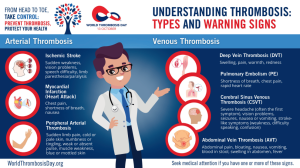
And one more pictorial about signs and symptoms of blood clots (Pictorial, courtesy of ‘Stop the Clot’)

Why do MPN patients clot?
Dr Cecily Forsyth’s presentation on thrombosis
Dr Cecily Forsyth gave an important presentation about thrombosis at the MPN Education Symposium in Perth in October 2025. We highly recommend watching her video and viewing her accompanying powerpoint presentation – HERE
Dr Forsyth covers the risk factors for MPN patients and provides many relatively simple ways to address those risk factors.
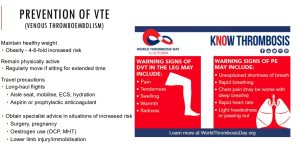
Here is a screenshot of a pictorial about preventing venous thromboses -from her talk.
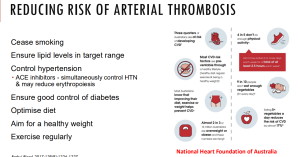
And a screenshot of a pictorial about preventing arterial thromboses from her talk.
Myelofibrosis patients – nuanced care
US cardiologist, Dr Orly Leiva, who has a special interest in MPNs, points out that while blood clotting is a known complication in MPN patients, thrombosis can still be a high risk for myelofibrosis (MF) patients, especially those who DON’T have low blood counts.
While the prevalence of thrombosis is mixed for MF patients, Dr Leiva’s research shows that one in 8 MF patients may develop a blood clot.
So he explains that mitigating thrombosis risk is important – while especially weighing pros and cons of treatment. On the one hand, MPNs are a pro clotting disorder so mitigation risk is important – but this needs to be very nuanced to find a perfect balance in MF patients due to the risk of bleeding as well.
For more information on thrombosis in MF, his video presentation at the 5 minute mark refers HERE.
How does cardiovascular health fit in with thrombosis risk?
The MPN AA’s page about cardiovascular health and MPNs has further information on MPNs and cardiovascular health and features further details from cardiologist Dr Leiva.
Additional links to patient resources about blood clots
The Thrombosis and Haemostatis society of Australia and New Zealand as well as the Clinical Excellence Commission in NSW also have developed patient resources.
-
- Blood clot prevention
How to prevent a blood clot developing - Further blood clots – prevention
How to prevent another clot developing - More information about the different types of clots.
Deep vein thrombosis
Pulmonary embolism
Splanchnic vein thrombosis (an article about MPNs and splanchnic vein thrombosis) - Travel and preventing blood clots
Practical in flight fitness tips to help avoid blood clots (courtesy of ‘Stop the Clot’)
- Blood clot prevention