JAK1/2 inhibition promotes aggressive cutaneous carcinogenesis through COT kinase–mediated alternative MAPK pathway activation,
Published: 2 November 2026, Journal of Clinical Investigation (JCI).
MPN AA note: this is a patient summary, largely prepared by CHATGPT. We are seeking clearance from the lead author to ensure its accuracy, but until that is received, please check the original article as AI can make errors.
The full article is free to access.
What was the research about?
This study investigated whether JAK inhibitors, particularly ruxolitinib (Jakavi), increase the risk of developing skin cancers.
JAK inhibitors are commonly used to treat myeloproliferative neoplasms, including myelofibrosis, polycythaemia vera and other blood and immune-related disorders.
Previous research had suggested an increased risk of non-melanoma skin cancers in patients taking these medications. This study went further by investigating why these skin cancers might develop and whether they could be more aggressive.
What did the researchers discover?
The researchers found three important things.
1. Increased risk of squamous cell skin cancer
They examined medical records from 1,004 patients with MPNs.136 patients had received JAK inhibitor treatment.
- 15 of these patients (11%) developed cutaneous squamous cell carcinoma (cSCC).
- Among patients who had not received JAK inhibitors, 14 (1.6%) developed this cancer.
The estimated 20-year cumulative incidence was:
- 13% in patients receiving JAK inhibitors.
- 3% in patients not receiving JAK inhibitors.
This represents a substantial difference.
2. The cancers appeared more aggressive
Of the 15 patients who developed skin cancer while receiving JAK inhibitors, six (40%) developed aggressive disease. This included cancers that had:
- Spread into surrounding tissues.
- Involved lymph nodes.
- Spread to other parts of the body.
In comparison, the skin cancers in patients who had not received JAK inhibitors were localised in this study.
3. They discovered a possible biological explanation
Normally, JAK1 and JAK2 proteins help regulate important signalling pathways involved in cell growth, immune function and inflammation. The researchers found that blocking these proteins can activate another pathway called the MAPK pathway, through a protein called COT kinase.
In simple terms:
- JAK inhibitors block normal JAK signalling.
- This can activate an alternative growth pathway.
- The alternative pathway can encourage abnormal skin cells to multiply.
- Existing precancerous skin lesions may then develop into more aggressive cancers.
The researchers demonstrated this mechanism in laboratory experiments and animal models, as well as finding supporting evidence in human skin cancer samples.
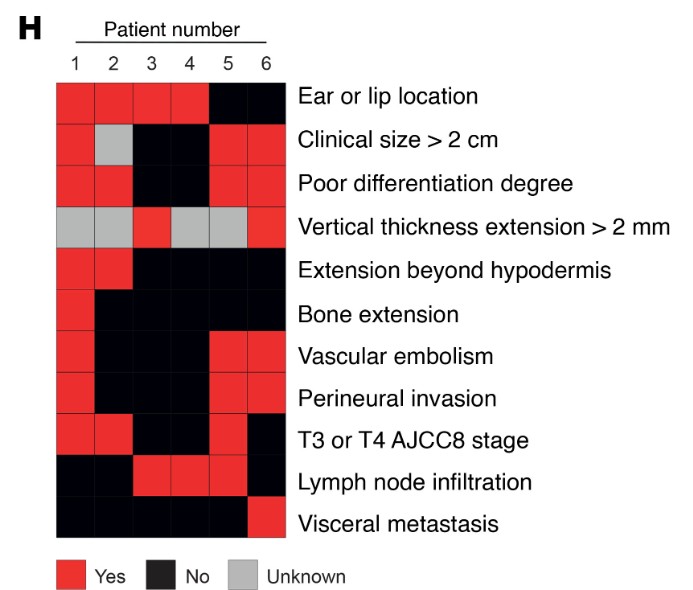
The above image (H in article), shows a “Heatmap depicting the clinical and histological aggressiveness criteria of the 6 aggressive cSCCs developed under JAK inhibitor treatment in patients with MPN. Presence or absence of aggressive criteria is represented in red or black, respectively. Absence of information is represented in gray.”
Does this apply to all JAK inhibitors?
The researchers investigated several different JAK inhibitors, which included: Ruxolitinib, Fedratinib, Momelotinib, and Pacritinib.
MPN AA note: ruxolitinib, momelotinib and fedratinib are currently approved for use in Australia on the PBS.
Their laboratory findings suggested that the effect was not restricted to ruxolitinib. JAK2 inhibition appeared to have the strongest effect, although JAK1 inhibition also produced some activation of the alternative growth pathway.
This raises the possibility that increased skin cancer risk could be a broader effect of JAK inhibitor treatment rather than a problem unique to one medication. However, the amount of clinical evidence differs considerably between individual drugs.
What does this mean for people with MPNs?
The findings are particularly relevant because people with MPNs already have several factors that can influence their risk of developing secondary cancers. These include:
- Age.
- Changes in immune system function associated with MPNs.
- Previous treatments.
- Long-term exposure to certain medications.
- Existing sun damage and precancerous skin lesions.
The researchers recommend careful dermatological monitoring of patients receiving JAK inhibitors. This means:
- Regular skin examinations.
- Checking new or changing skin lesions.
- Investigating persistent scaly, crusted or non-healing areas.
- Prompt assessment of suspicious lesions.
What are the limitations of the research?
Although this is an important study, there are some qualifications.
- The patient cohort came from one specialist MPN centre, so findings may not represent every MPN population.
- The number of patients who developed skin cancer was relatively small.
- Some of the mechanistic evidence came from laboratory and animal experiments rather than direct observations in patients.
- The study does not establish the precise risk associated with every individual JAK inhibitor.
- The 20-year cumulative incidence figures are estimates, not the proportion of patients who will necessarily develop cancer.
Importantly, the findings do not mean that everyone taking a JAK inhibitor will develop skin cancer.
Why is this research important?
Firstly, it reinforces the need to consider long-term cancer risks when selecting treatments for MPNs. A medication may be very effective at controlling an MPN but may also have consequences that need monitoring over many years.
Secondly, it provides a possible biological explanation for why some skin cancers developing during JAK inhibitor treatment may behave more aggressively. This second point could eventually help researchers develop safer treatments or identify patients who need closer monitoring.
It adds to the evidence that ruxolitinib and potentially other JAK inhibitors deserve careful long-term safety monitoring, particularly for skin cancers.