
A big moment for Australian CALR research has just landed — and it’s one the MPN Alliance Australia helped spark.
At the 2025 American Society of Hematology (ASH) meeting, A/Prof Dan Thomas and Dr Chloe Thompson-Peach unveiled their work, Ultraprecision treatment for myelofibrosis from Type 1 CALR and Type 2 CALR. Dr Thompson-Peach led the study, which showed that Type 1 and Type 2 CALR mutations behave differently — and that if you target those differences properly, you may be able to deliver far better outcomes for patients.
What makes this especially exciting for the MPN community is that this breakthrough had its beginnings in a grassroots effort. Back in 2022, shortly after her diagnosis, MPN patient Sarah Gardner ran a raffle to raise money for MPN research. Her efforts directly funded an MPN Alliance Australia Fellowship grant awarded to Dr Thompson-Peach in August 2022 — early support that helped this project get off the ground.
The key takeaway is huge: this research points to the possibility of treating CALR driven myelofibrosis by using immunotherapy to target the abnormal blood cells that actually drive the disease — not just managing symptoms.
It’s a shift toward precision treatment that could change the game for CALR-positive patients.
This article shares more about Sarah Gardner’s MPN story as well as explaining how Chloe’s research has enabled these exciting developments for MPN patients with the CALR mutation.
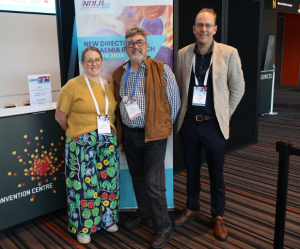
Image: Dr Chloe Thompson-Peach with A/Professor Dan Thomas and the MPN AA’s Ken Young
Soon, you too will be able to help research into MPNs. The MPN AA is finalising a donations page for our website and when it is live, we’ll let you know. To keep in the loop, sign up to our newsletter and follow us on Facebook and Instagram.
